
The Payments Council of India has confirmed that Unified Payments Interface (UPI) services will continue to be free for consumers and small merchants, despite a recent Lok Sabha Bill. This clarification addresses concerns about potential charges, emphasising that while a sustainable financial model for UPI infrastructure is being developed, transaction charges will not be passed on to users or small businesses.

Analysts predict that the Reserve Bank of India's interest rate decision, the evolving situation in West Asia involving the US-Iran conflict, and crude oil prices will be the primary factors influencing investor sentiment in the Indian stock market this week.

The Reserve Bank of India's Financial Stability Report indicates that the interim peace deal between the US and Iran has favourably shifted the balance of risks, reducing headwinds from the West Asia conflict. However, it cautions that exchange rate volatility could increase if crude oil prices spike due to delayed normalisation of supply chain disruptions.

'A balance had to be struck between the economic cost of taking action at this point against the need not to fall behind the curve in controlling inflation and anchoring inflation expectations.'

The Reserve Bank of India (RBI) has issued a statement assuring the public of HDFC Bank's stability and sound financial position following the resignation of its chairman, Atanu Chakraborty, citing ethical concerns.
RBI Governor Sanjay Malhotra stated it is "premature" to discuss the implementation of Merchant Discount Rate (MDR) for digital payments, advising a "wait-and-watch" approach. He emphasised that investment in public payment infrastructure is necessary and someone must bear the cost, whether through taxes or MDR. The government is currently working on amendments to relevant statutes, and the RBI is focused on strengthening this infrastructure.

In the draft norms issued last month, the RBI said that the ultimate responsibility for the bank's performance, conduct and control rests with the Board

A Bank of Baroda employee in Ahmedabad has been arrested for allegedly stealing Rs 8.7 crore from an RBI currency chest and laundering the money into properties and cryptocurrency.

US Federal Reserve Chairman Kevin Warsh has picked former RBI governor Raghuram Rajan, Harvard University economics Professor Raj Chetty and Microsoft XBOX CEO Asha Sharma to be part of task forces constituted to examine the central bank's approach to monetary policy and propose transformational changes.

India's largest retirement fund manager, the Employees' Provident Fund Organisation (EPFO), is enhancing its investment governance and fund management practices, following the Reserve Bank of India's recommendations.

India's retail inflation rose to 4.38 per cent in June, driven primarily by costlier food items, pushing it above the Reserve Bank of India's median target of 4 per cent for the first time under the new series.

Kerala Police chief Ravada Chandrasekhar highlighted cyber fraud as a serious social challenge, particularly targeting youth, during the inauguration of 'RBI Reelathon 2026'. This multi-phase awareness campaign by the Reserve Bank of India aims to engage college students in combating cyber financial frauds through creative content creation and timely reporting.

The World Bank has increased India's economic growth projection for FY27 to 6.6 per cent, citing resilient domestic demand, while simultaneously cutting its global economic growth outlook due to the conflict in West Asia.
Moody's Ratings has sharply increased India's GDP growth forecast for fiscal 2026-27 to 7 per cent, making it the fastest among G20 economies, driven by economic resilience despite the Middle East conflict. However, the agency flagged significant inflation risks stemming from elevated oil prices and potential El Nino disruptions.

Reserve Bank of India Deputy Governor Rohit Jain has stated that India cannot rely solely on bank balance sheets to fund the extensive investment required for its 'Viksit Bharat' (developed India) goal by 2047, emphasising the critical need for deeper corporate bond, foreign exchange, and derivatives markets.

India's forex reserves increased by $392 million to $687 billion during the week ended January 9, the Reserve Bank of India said on Friday.

Indian stock market indices closed on a mixed note, with the Sensex gaining 374 points driven by buying in Reliance Industries and ICICI Bank, while the Nifty remained flat. This divergence is attributed to a new Closing Auction Session (CAS) mechanism introduced by stock exchanges, impacting market liquidity and price discovery.

India and China are in what experts call 'a cooperation-versus-competition situation'.

A new report by Motilal Oswal Financial Services Ltd (MOFSL) indicates that inflation, interest rates, and monetary policy have become more significant drivers of gold prices than traditional geopolitical conflicts, with markets increasingly focusing on these economic factors.

The Reserve Bank of India (RBI) is anticipated to make its highest-ever dividend payment to the government this year, providing a significant fiscal boost to address challenges, including those stemming from the ongoing Middle East crisis.

Indian stock markets this week will be primarily influenced by a series of corporate Q1 earnings, the evolving geopolitical situation in West Asia, and fluctuations in crude oil prices, according to market analysts.

Market participants are keenly awaiting regular, preferably weekly, updates from the Reserve Bank of India (RBI) on Foreign Currency Non-Resident (Bank), or FCNR (B), deposits, following the central bank's directive for banks to submit daily data on these inflows.

Non-banking financial companies (NBFCs) in India saw their overall credit growth accelerate to 14.2 per cent year-on-year in May, primarily driven by significant increases in loans against gold jewellery and commercial real estate, according to recent Reserve Bank of India (RBI) data.

Bank of Baroda has partnered with Reliance Jio to provide access to its mobile banking application, 'bob World Lite', for users of Jio feature phones, aiming to promote financial inclusion and digital payments.

India's foreign exchange reserves have surged by $3.825 billion to reach $700.946 billion as of April 10, marking a significant milestone for the country's financial stability.

On the 25th anniversary of that world-changing morning in New York, it is also for the rest of to reflect. Not only on those who were killed but also on why the event happened and what led to it and what came after it, asserts Aakar Patel.
Fitch Ratings has affirmed India's sovereign credit rating at 'BBB-' with a stable outlook, acknowledging robust growth prospects and strong external finances. However, the agency highlighted concerns over elevated government debt, lagging structural metrics, and potential fiscal spending pressures due to rising youth unemployment.

The RBI once again said the Tata group holding company's application for deregistration as an NBFC remains under examination.

The Supreme Court has directed the Central Bureau of Investigation (CBI) to examine all six allegations of financial irregularities levelled by the Enforcement Directorate against Sameer Gehlaut, former chairperson of Indiabulls Housing Finance (IHFL), and five corporate groups, following repeated criticism of investigating agencies for lack of progress.
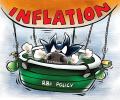
The Reserve Bank of India has increased its retail inflation projection for 2026-27 to 5.1 per cent, up from an earlier estimate of 4.6 per cent. This revision is primarily attributed to mounting input costs, driven by the pass-through of higher global energy prices to domestic petrol and diesel rates, which have seen significant increases since May.

The FCNR (B) stratagem relies on using public money to defend the rupee. The State subsidises foreign borrowing to attract dollars. This tool requires large-scale borrowing to make a material difference against a gross external flow of $11 billion a day. A commensurately large fiscal cost falls upon the exchequer. The ministry of finance will choose how much it is willing to spend in exchange for this round number, points out Ajay Shah.

Gold and silver prices are anticipated to maintain a positive trajectory in the coming week, with market volatility expected to remain high due to ongoing developments in West Asia and upcoming global economic data, particularly the Federal Reserve's FOMC meeting minutes.

The Reserve Bank of India's proposal to allow non-banking financial companies (NBFCs) access to the term money market is projected to significantly increase market volumes by 40-60 per cent in the first year, potentially doubling turnover within two to three years, according to treasury executives.

Atanu Chakraborty has resigned as chairman of HDFC Bank, citing ethical concerns, marking an unusual departure and prompting the appointment of an interim chairman.

Finance Minister Nirmala Sitharaman met with bank heads to discuss risks related to Artificial Intelligence (AI) following global concerns over Anthropic's Mythos model and its potential threat to financial systems' data security.

India's foreign exchange reserves jumped by $14 billion to $701 billion during the week ended January 16, the Reserve Bank said on Friday. The overall reserves had increased by $392 million to $687 billion in the preceding week.
The Reserve Bank of India (RBI) was a net seller of the US dollar in August, reversing its net buying position from July. During the current financial year up to August, the central bank had sold a net $1.11 billion. The RBI sold a net total of $6.49 billion worth of the foreign currency in August, according to the central bank's monthly bulletin.

'You have to get private investment to somewhere between 35% to 36% of GDP. It is hovering about 30%-31%.'

'Every period of excessive optimism eventually gives way to a correction, while periods of extreme pessimism often create the best investment opportunities.'

Economists highlight that resolving domestic policy bottlenecks, particularly through land reforms and improving the ease of doing business, will be critical for Prime Minister Narendra Modi's 'next-generation reforms' and India's economic transformation towards its 'Viksit Bharat' vision for 2047.
